With early voting approaching in Tennessee’s Republican primary for governor, front-runner Marsha Blackburn is facing renewed questions over debates, media access and whether voters will get to compare the candidates directly before casting ballots.
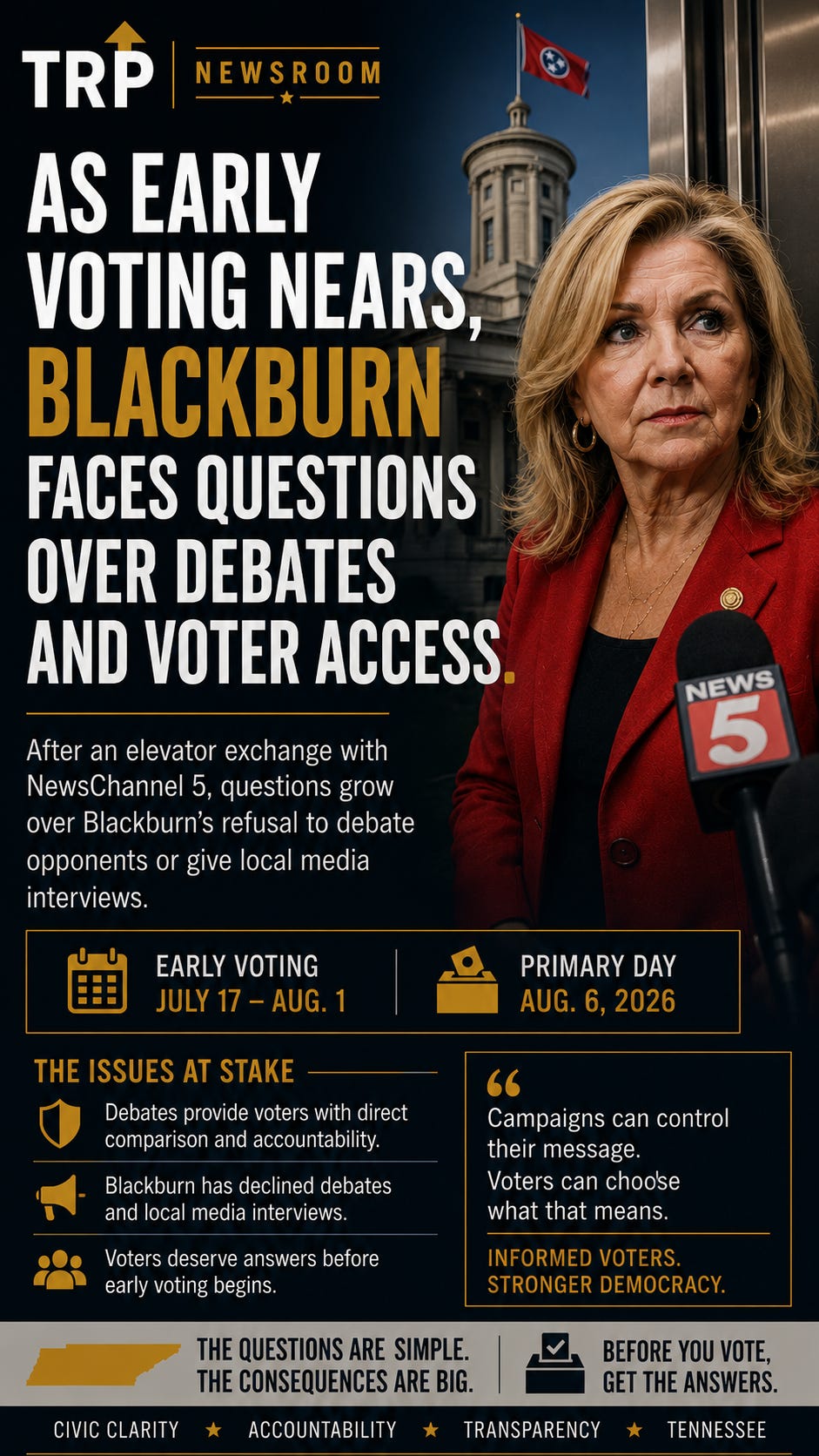
Blackburn, a sitting U.S. senator, is running against Republican opponents including U.S. Rep. John Rose and state Rep. Monty Fritts. The primary is scheduled for Aug. 6. Early voting begins July 17 and runs through Aug. 1.
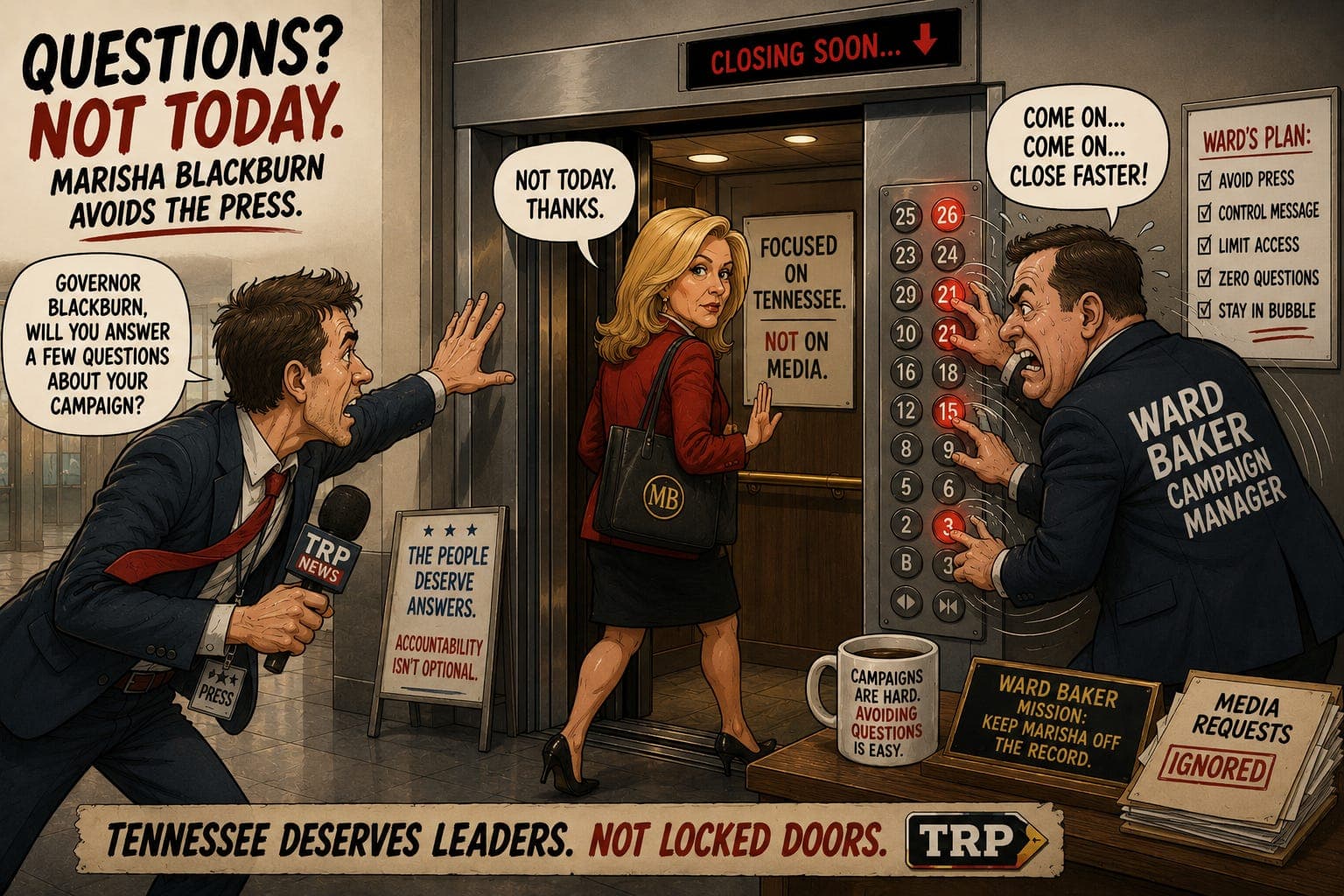
The access issue sharpened after a NewsChannel 5 exchange in Nashville showed Blackburn repeatedly declining to answer questions about her campaign while waiting for an elevator after an event.
NewsChannel 5 reported Blackburn had just spoken to the Greater Nashville Technology Council and that organizers had invited local media and said Blackburn would take questions afterward. Instead, the station reported, Blackburn left after her speech and headed for an elevator.
When NewsChannel 5 investigative reporter Ben Hall asked Blackburn about her run for governor, debates and whether voters have a right to hear from her, Blackburn repeatedly responded that she was “talking to Tennesseans every single day.”
The station reported Blackburn has refused to debate her Republican opponents and has not granted local media interviews, including multiple requests from NewsChannel 5.
Blackburn later said on conservative talk radio that she had been attending a federal event and could not answer campaign questions because she was on “federal time,” according to NewsChannel 5. The station reported that some Republicans and conservative commentators questioned that explanation, saying federal law restricts the use of taxpayer resources for campaign activity but does not bar an elected official from answering political questions in a public hallway after an event.
NewsChannel 5 reported it asked Blackburn’s office for comment on its follow-up story but did not receive a response.
The video drew national attention after The Daily Beast reported on the exchange and described Blackburn as the leading Republican candidate in the race. The outlet also reported she has refused to debate Republican opponents and has not been giving media interviews to promote her campaign.
The issue is not whether a candidate is legally required to participate in every forum or answer every media question. Candidates are free to make strategic decisions about where they appear, which interviews they accept and how much risk they take in unscripted settings.
The voter question is different.
When early voting is close, avoiding debates and local media questions becomes more than a scheduling issue. It becomes a voter-information issue.
A public East Tennessee Young Republicans forum listing shows Fritts and Rose confirmed for a July 10 gubernatorial forum at Jewelry Television, with Blackburn listed as invited. The listing reviewed by The Redemption Project Newsroom did not show Blackburn as confirmed.
TRP has not independently confirmed whether Blackburn declined the invitation, did not respond or remains pending.
Rose has publicly pressed for debates. A social media post from his campaign said he began calling for a debate 319 days earlier and asked where Blackburn was with early voting approaching.
Tennessee Lookout columnist Sam Stockard wrote in June that early voting was less than a month away and that top Republican gubernatorial candidates had not agreed to a forum. The column framed the lack of debate as part of the broader primary dynamic.
Blackburn entered the governor’s race in 2025 as one of the highest-profile Republicans in Tennessee. The Associated Press reported her entry created a high-profile Republican primary battle with Rose. Reuters reported she had served in Congress for more than two decades, was Tennessee’s first female U.S. senator and had won reelection in 2024 by a wide margin.
That status matters because front-runners often have less incentive to debate.
Candidates with strong name recognition, major endorsements or polling advantages may decide shared debate stages benefit lower-profile opponents more than themselves. Campaigns also may prefer controlled events, friendly media appearances, direct voter contact and paid messaging over unscripted exchanges.
That is a common campaign strategy.
It is also one voters can judge.
Rose and Fritts have an interest in drawing Blackburn onto a shared stage. Blackburn has an interest in controlling the pace, setting and message of her campaign. Republican primary voters have an interest in hearing candidates answer the same questions, in the same room, before ballots are cast.
Those interests are not the same.
Debates do not guarantee truth. Forums can reward performance over substance. Media questions can be imperfect. Candidates can avoid answering even when they appear.
But debates and unscripted interviews still give voters something campaign ads cannot: comparison under pressure.
They allow voters to hear how candidates answer questions they did not write, respond to challenges they did not choose and explain positions when another candidate is standing nearby.
In a governor’s race, that matters.
The governor controls the executive branch of state government. The next governor will shape budget priorities, agency leadership, education policy, public safety strategy, health policy, emergency response, economic development and Tennessee’s relationship with the federal government.
Primary voters are not only choosing a campaign message.
They are choosing a potential chief executive.
That is why access matters.
The question is not whether Blackburn is allowed to run a cautious campaign. She is.
The question is whether Republican voters will get a meaningful opportunity to compare the candidates before early voting begins.
Campaigns are free to control their message.
Voters are free to notice when they do.
Several questions remain open.
Will Blackburn participate in any Republican primary debate before early voting begins?
Will she accept local media interviews about her campaign?
Will the East Tennessee Young Republicans forum include only Rose and Fritts, or will Blackburn appear?
Will the Blackburn campaign explain its debate position directly to voters?
And will Republican voters view limited debate participation as a campaign strategy, a voter-access problem or a nonissue?
The primary calendar gives those questions urgency.
The Tennessee Secretary of State lists Aug. 6 as the 2026 state and federal primary election date. County election information lists early voting for the Aug. 6 election as July 17 through Aug. 1.
That means the comparison window is narrowing.
The elevator exchange became the viral moment.
The larger civic issue is whether voters will get direct answers before voting starts.
I am a retired detective and criminal justice / government educator based in Tennessee. I am a commentary write for Tennessee Lookout and a weekly columnist with Knox TN Today. My work examines public policy, public safety systems and civic responsibility. My reporting and commentary have also appeared in Governing, The Arizona Capitol Times, South Florida Sun Sentinel, Police1, among other state and regional outlets.