Senate committee advances bill targeting forced organ harvesting in China
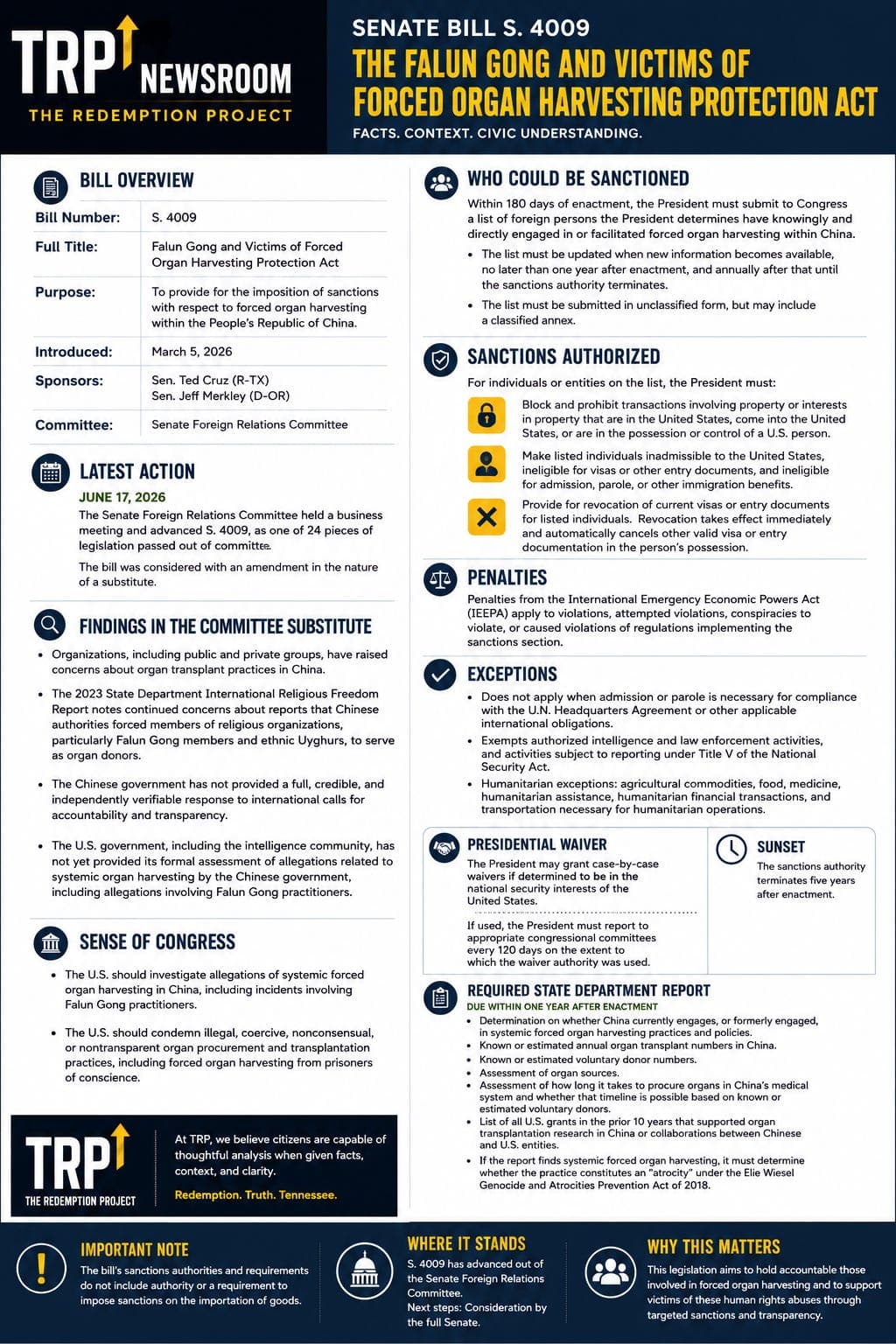
by Brandon Burley and The Redemption Project WASHINGTON — A Senate committee has advanced legislation that would require the U.S. government to formally assess allegations of forced organ harvesting in China and impose sanctions on foreign persons determined to be directly involved. At the center of the bill is a question Congress wants formally answered: Are organs being taken from people against their will inside China, and if so, what should the United States do about it? The bill, S. 4009, is titled the Falun Gong and Victims of Forced Organ Harvesting Protection Act. It was introduced by U.S. Sen. Ted Cruz, R-Texas, with U.S. Sen. Jeff Merkley, D-Ore., as a cosponsor. Both senators serve on the Senate Foreign Relations Committee. The Senate Foreign Relations Committee announced June 17 that it had advanced 24 pieces of legislation, including S. 4009. The bill was considered with an amendment in the nature of a substitute, meaning the committee version would replace the earlier text if adopted by the Senate. The legislation has not become law. It would still need to pass the full Senate, be reconciled with any House version and be signed by the president before taking effect. The bill responds to long-running allegations that prisoners of conscience and other vulnerable groups have been used as involuntary organ sources inside China. The Chinese government has denied forced organ harvesting allegations and has said its transplant system relies on voluntary donations. Human rights groups, lawmakers and international experts have continued to question the transparency of China’s transplant system, including reported transplant wait times, donor numbers and the treatment of prisoners of conscience. The Senate bill is designed to address those concerns in two main ways: targeted sanctions and a formal State Department report. Under the committee version, the president would have 180 days after enactment to submit a list to Congress identifying foreign persons determined to have knowingly and directly engaged in or facilitated forced organ harvesting in China. The list would be submitted in unclassified form but could include a classified annex. People or entities placed on that list would face property-blocking sanctions. That means the president would be required to block and prohibit transactions involving their property or interests in property if those assets are in the United States, come into the United States or are in the possession or control of a U.S. person. Listed individuals also would be barred from entering the United States. The bill would make them inadmissible, ineligible for visas or other entry documents, and ineligible for admission, parole or other immigration benefits. Existing visas or entry documents could also be revoked. The bill defines forced organ harvesting as the removal of one or more organs from a person through coercion, abduction, deception, fraud, abuse of power or abuse of a position of vulnerability. Although Falun Gong practitioners are named prominently in the bill, the committee substitute also refers to other victims and to allegations involving ethnic Uyghurs and people targeted by Chinese authorities because of religion, ethnicity or other affiliation. The bill’s findings cite the State Department’s 2023 International Religious Freedom Report, which said civil society organizations continued to express concern over reports that Chinese authorities forced members of religious organizations, “in particular Falun Gong members and ethnic Uyghurs,” to serve as organ donors. The measure includes several limits and exceptions. Visa restrictions would not apply when admission or parole is necessary for the United States to comply with the U.N. Headquarters Agreement or other international obligations. The sanctions section also exempts authorized intelligence and law enforcement activities. Humanitarian activity is also protected. The bill says sanctions may not be imposed on transactions involving agricultural commodities, food, medicine, humanitarian assistance, humanitarian financial transactions or transportation needed for humanitarian operations. The president would also have waiver authority. Sanctions could be waived on a case-by-case basis if the president determines the waiver is in the national security interests of the United States. If that authority is used, the president would have to report to the appropriate congressional committees every 120 days on the extent to which waivers were granted. The sanctions authority would expire five years after enactment. The second major piece of the bill is the required State Department report. Within one year after enactment, the secretary of state, in consultation with the secretary of health and human services, the director of the National Institutes of Health and relevant intelligence community officials, would have to report to Congress on China’s organ transplant policies and practices. That report would have to include a formal determination on whether the Chinese government currently engages, or formerly engaged, in systemic forced organ harvesting practices and policies. The report would also have to summarize China’s formal and informal organ transplant policies, including policies involving prisoners of conscience, Falun Gong practitioners, other prisoners and victims of forced organ harvesting. Subscribe now The bill requires the report to include known or estimated annual organ transplant numbers in China, known or estimated voluntary donor numbers, an assessment of organ sources and an assessment of how long it takes to procure organs in China’s medical system. That timing question is important because one of the long-running concerns raised by critics of China’s transplant system is whether reported transplant wait times can be explained by voluntary donation alone. The report would also have to list all U.S. grants during the previous 10 years that supported organ transplantation research in China or collaboration between Chinese and U.S. entities. If the State Department determines that China currently engages, or formerly engaged, in systemic forced organ harvesting, the report would also have to determine whether the practice constitutes an atrocity under the Elie Wiesel Genocide and Atrocities Prevention Act of 2018. The bill includes one important limit: Its sanctions authorities do not include authority or a requirement to impose sanctions on the importation of goods. That means the bill is aimed primarily at people and entities allegedly involved in forced organ harvesting, not broad trade restrictions on Chinese products. Supporters describe the measure as a human rights and accountability bill. Cruz’s office said when the bill was introduced that it would impose sanctions on those responsible for forced organ harvesting in China and direct the secretary of state to report to Congress on China’s organ harvesting policies and transplant system. Merkley said in the same release that reports of forced organ harvesting from vulnerable groups in China are among the consequences of repression and human rights abuses. The issue is not new in Congress. A separate House bill, H.R. 1503, the Stop Forced Organ Harvesting Act of 2025, passed the House in May 2025 by a wide bipartisan margin. That bill addresses the same broader issue but is not the same measure as S. 4009. For now, the Senate bill’s advancement out of committee means lawmakers have moved the issue forward procedurally. It does not mean the bill has passed the Senate or become law. The next question is whether Senate leaders bring the measure to the floor, whether it passes the full Senate, and how it would be reconciled with House legislation aimed at the same broader problem. The civic significance is straightforward: Congress is considering whether allegations about China’s organ transplant system should trigger formal U.S. reporting, targeted sanctions, visa bans and a defined accountability structure. The bill does not ask Americans to resolve every allegation on their own. It asks the U.S. government to make formal determinations, identify responsible foreign persons and use sanctions tools if the evidence supports doing so. I am a retired detective and criminal justice / government educator based in Tennessee. I am a commentary write for Tennessee Lookout and a weekly columnist with Knox TN Today . My work examines public policy, public safety systems and civic responsibility. My reporting and commentary have also appeared in Governing , The Arizona Capitol Times , South Florida Sun Sentinel , Police1 , among other state and regional outlets. Subscribe now
See an error? Request a correction