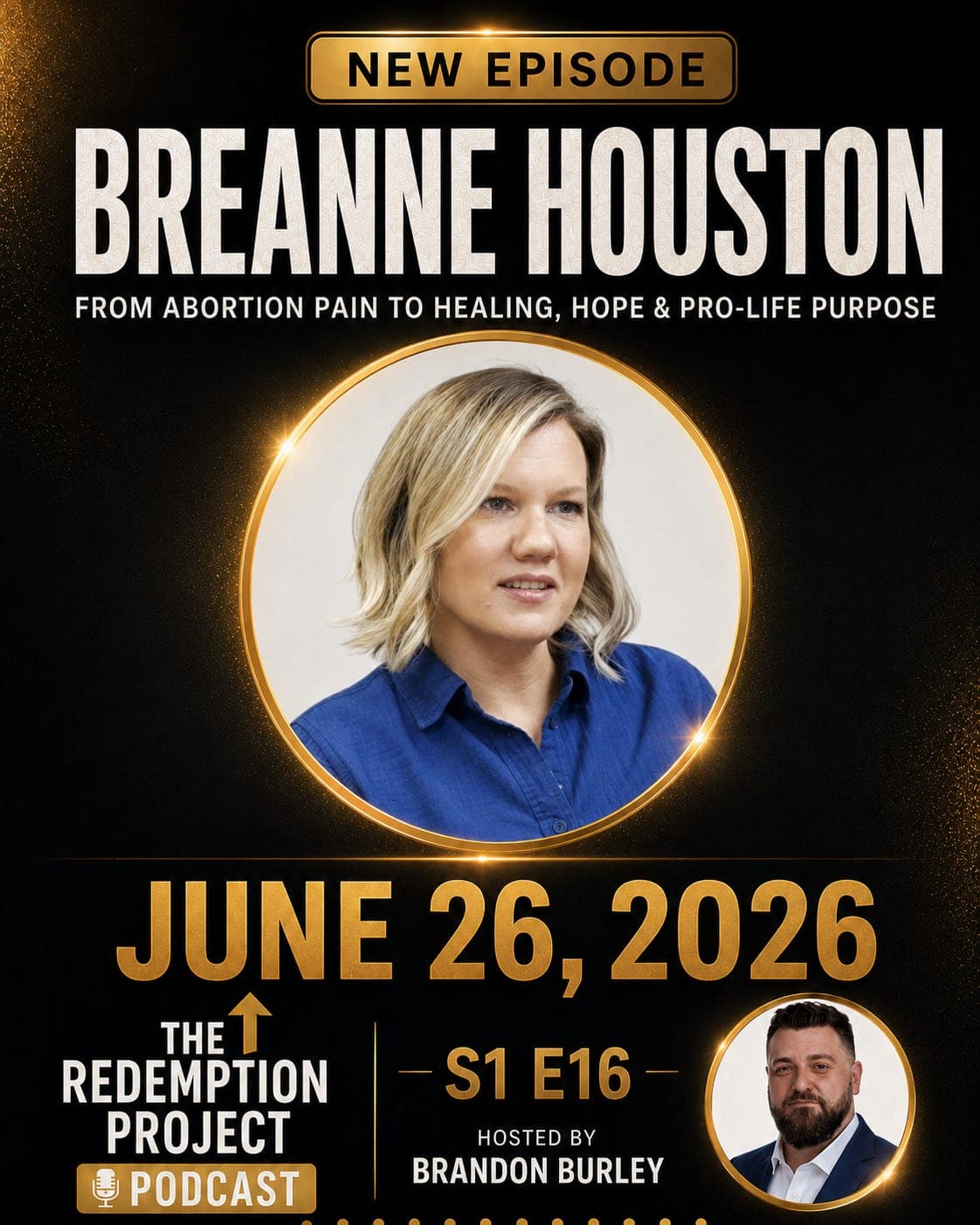
From Abortion Pain to Healing, Hope and Purpose: The Redemption Story of Breanna Houston

by Brandon Burley and The Redemption Project Breanna Houston remembers being 18 years old, living in a college dorm and realizing she was pregnant. She was scared. She was the first in her family to attend college. She had plans. She wanted a future in television. She wanted to be a producer. And in that moment, the story she had absorbed from the world around her seemed simple: A pregnancy would ruin everything. So she did what many young women do when fear becomes louder than everything else. She kept it quiet. She did not tell her parents. She went to Planned Parenthood. Her story is Season 1, Episode 16 of The Redemption Project . It is a story about abortion, grief, faith, forgiveness and what happens when the part of your life you most want to hide becomes the place where God begins His deepest work. Breanna did not grow up in a deeply discipled Christian home. She was introduced to faith as a child, but by the time she reached college, God was not the center of her life. She was focused on friends, boys and the future she wanted to build. Then she got pregnant. At 18, away from home and with her future seemingly on the line, she panicked. She knew her parents loved her. She believed they would have helped her. But fear has a way of narrowing a person’s vision. She carried the weight of being the first in her family to attend college and did not want to disappoint anyone. So she looked for what the culture had told her was the solution. “I have this problem,” she remembered thinking. “This is what you do.” Before the abortion, Breanna believes God tried to reach her. She describes preparing for the appointment and suddenly having what she now sees as a spiritual encounter. At the time, she thought it might have been a panic attack. Looking back, she believes the Lord was showing her the truth. But fear kept moving her forward. At the clinic, she remembers the ultrasound. She was told she was around eight weeks pregnant. She looked at the screen and saw what appeared to be a small dot. Her reaction was relief. She thought they had caught it in time. One of the painful realities of Breanna’s story is that she did not fully understand what was happening. Not because she lacked intelligence or compassion, but because she was young, frightened and processing everything through the lens she had been given. When she returned for the abortion, the atmosphere felt different. She remembers the pace, the sounds, the pain and eventually being sent home. Then she slept. But something had changed. She could not yet put words to it, but she felt loss. And that loss followed her for year s. Later, Breanna heard the Gospel in a small church and broke down. She remembers retreating to a bathroom and crying uncontrollably as the truth of God’s grace finally reached places she had spent years trying to hide. She accepted Christ’s forgiveness. But accepting forgiveness from God and receiving it fully in your own heart are not always the same thing. For years, Breanna carried unforgiveness toward herself. It was a quiet prison. No bars. No public sentence. Just the same private accusation repeated again and again. Life moved forward. She married. She had children. The abortion became part of her past. Or so she thought. Then one day, after the birth of her son Oliver, she was sitting in her kitchen. An ultrasound picture from early in her pregnancy was attached to the refrigerator. She looked at the image. Then she looked at her six-month-old son. Then she looked back at the ultrasound. In that moment, years of buried grief surfaced all at once. The pain finally had a name. The loss became real in a way it never had before. Grief does not always wait for understanding before it arrives. For a season, the weight of that realization pulled her into a darker place. But God was not finished with her story. Not long afterward, her church offered a Bible study for women who had experienced abortion called Forgiven and Set Free. Breanna attended. The study did not erase the past. It did not make the abortion disappear. What it did was force her to confront a truth she had spent years resisting. If Christ had forgiven her, who was she to continue condemning herself? She came to understand that holding on to unforgiveness was not humility. It was refusing to receive a gift Christ had already given. That realization changed everything. Not overnight. But steadily. The grief remained real. The forgiveness became real, too. For the first time, Breanna began to understand that redemption is not pretending sin never happened. Redemption is what happens when God’s grace reaches the very place where shame once lived. Over time, God began transforming the most painful chapter of her story into a ministry for others. Today, Breanna works with Alliance Family Services and is helping develop a pregnancy-resource clinic effort in Lenoir City. Her desire is simple: to meet women in moments of fear and help them understand they are not alone. To provide support before panic makes the decision. To offer hope before someone believes there are no options. To share truth, compassion, practical help and the Gospel with women facing some of the hardest moments of their lives. Before the ministry, there was mercy. Before the mission, there was grace. Before she could help others, God had to heal her. That is what makes this a redemption story. Not that the past disappeared. Not that the wound was erased. But that the wound did not get the final word. Today, Breanna wants women facing unexpected pregnancies to know they are not alone. She wants women carrying abortion grief to know they are not beyond forgiveness. And she wants people who believe their worst decision defines them to know something she learned the hard way: God’s grace reaches farther than our shame. The chapter Breanna most wanted hidden became the chapter God used most. That is redemption. And that is why her story matters. I am a retired detective and criminal justice / government educator based in Tennessee. I am a commentary write for Tennessee Lookout and a weekly columnist with Knox TN Today . My work examines public policy, public safety systems and civic responsibility. My reporting and commentary have also appeared in Governing , The Arizona Capitol Times , South Florida Sun Sentinel , Police1 , among other state and regional outlets. Subscribe now
See an error? Request a correction