The Redemption Project Newsroom
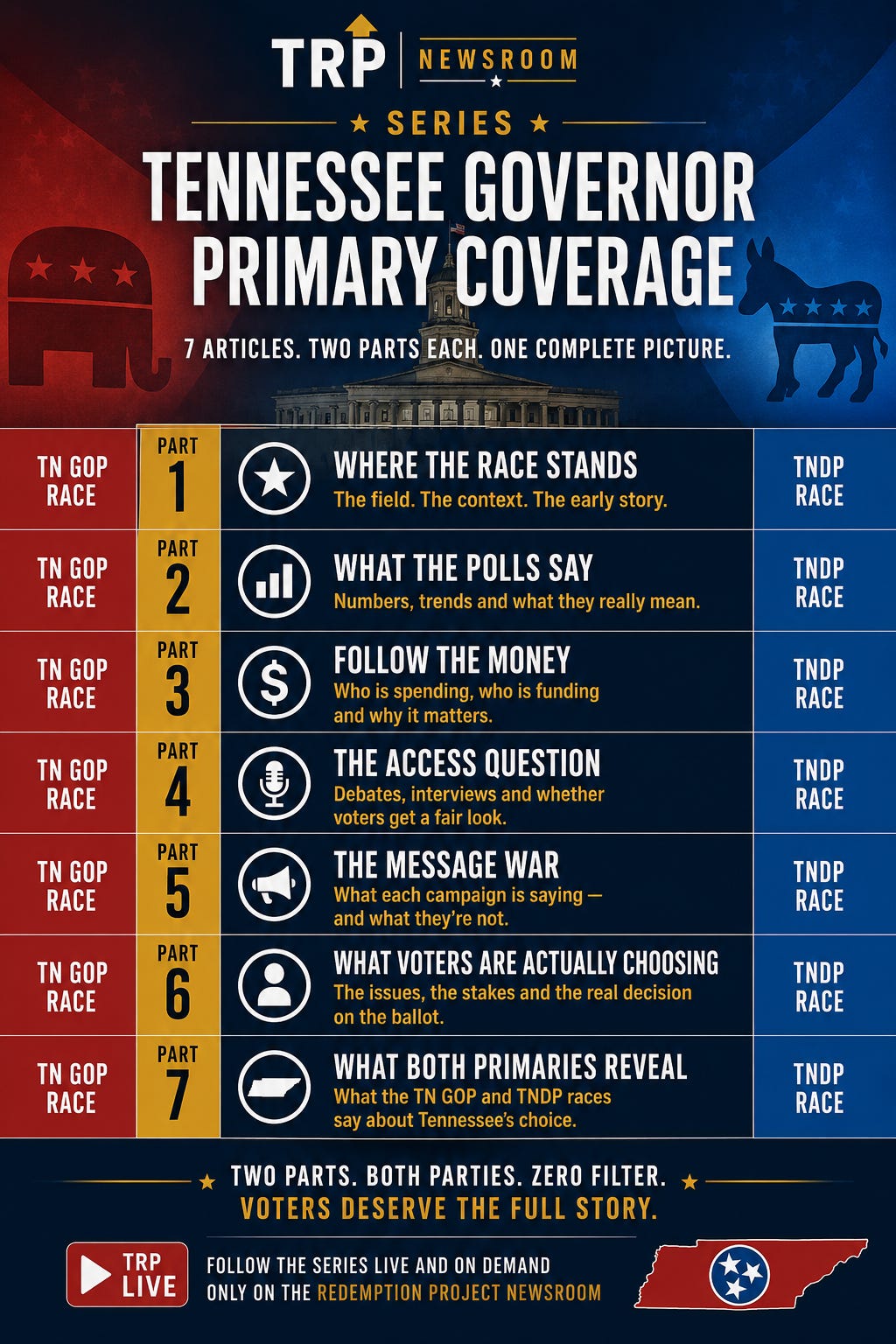
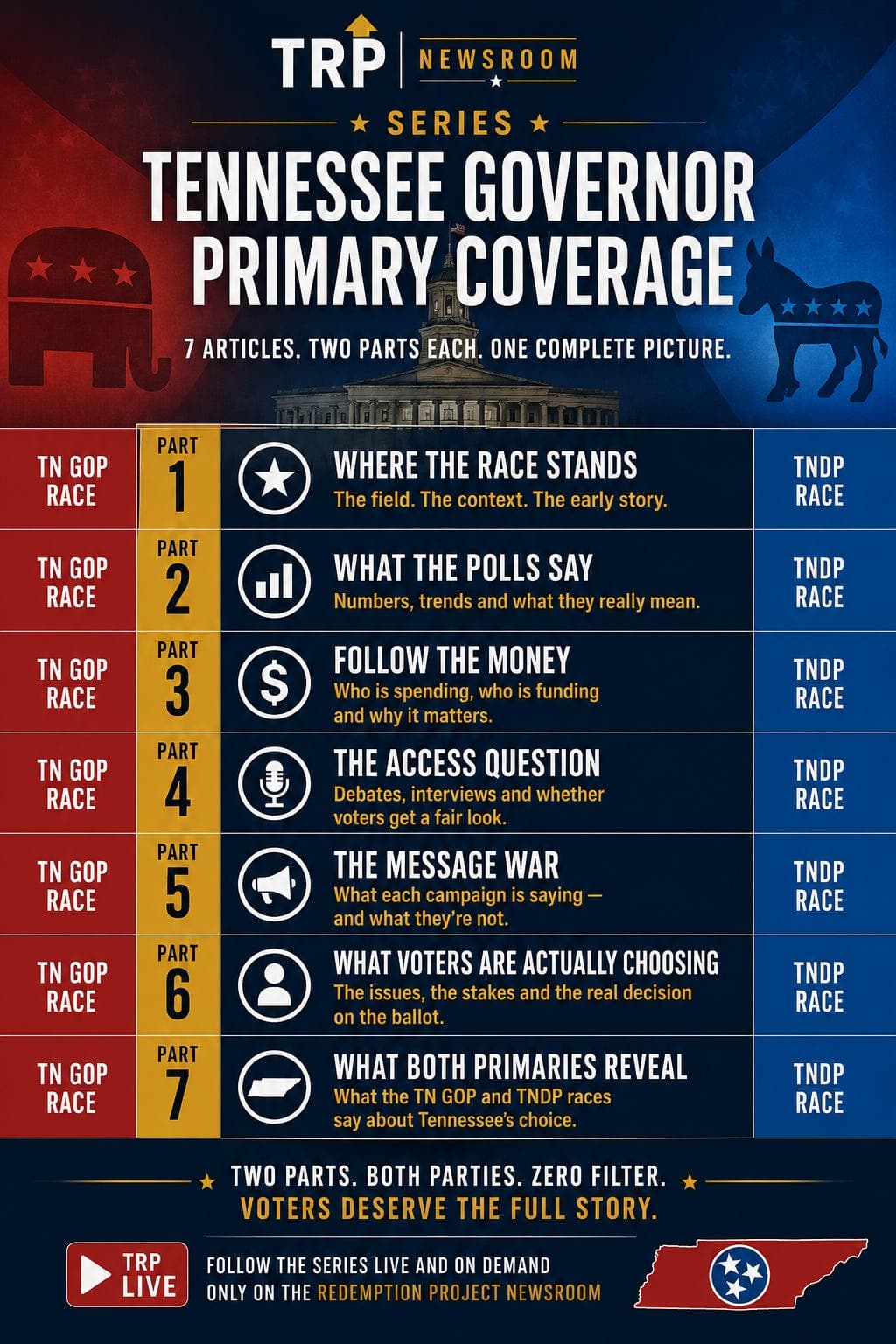
Editor’s note: This article is part of TRP’s side-by-side series on Tennessee’s Republican and Democratic primaries for governor. Each installment applies the same civic question to both races while recognizing that the two primaries are not the same kind of contest.
Tennessee’s Republican primary for governor is becoming harder to describe with one word.
For much of the race, the public evidence pointed in the same direction: U.S. Sen. Marsha Blackburn was the clear frontrunner. She entered with statewide name recognition, two Senate victories, national conservative credentials and a political profile few Tennessee Republicans could match.
That remains the safest read of the race.
But it is no longer the whole story.
As early voting approaches, the Republican primary has become a voter-information test involving polling, campaign money, candidate access, debate participation and whether voters get a meaningful side-by-side comparison before casting ballots.
The public polling still favors Blackburn. The strongest late-spring public benchmark came from the Beacon/TennSight May 2026 poll, fielded April 20-27, which showed Blackburn at 63%, U.S. Rep. John Rose at 10% and state Rep. Monty Fritts at 5% among Tennessee Republican primary voters.
That result continued a pattern that had held for months. Polls tracked by Tennessee Firefly and Beacon showed Blackburn with large leads from 2025 into spring 2026, even as Rose remained in the race and Fritts entered the field.
Then the race shifted publicly in late June.
Rose released an internal McLaughlin & Associates poll showing Blackburn still leading, but by a smaller margin: Blackburn 44%, Rose 29%, Fritts 12% and 15% undecided, according to NewsChannel 5 reporting. The poll surveyed 600 likely Republican voters, but full crosstabs, question wording and regional breakdowns were not publicly available in the reporting reviewed.
That means the poll should be treated as a signal, not a conclusion.
It does not show Rose leading. It does not prove Blackburn is collapsing. It does not show Fritts cannot matter.
It does raise a fair question: has the Republican primary moved from a frontrunner assumption into a voter-comparison phase?
The candidates are running from different positions.
Blackburn’s campaign is built around trust, familiarity and conservative identity. She is a sitting U.S. senator, a known statewide Republican figure and a Trump-aligned conservative. AP reported when she entered the race that she could become Tennessee’s first female governor and could run without risking her Senate seat after winning reelection in 2024.
Rose’s campaign is built around exposure. AP reported when he launched that he framed himself as a conservative outsider, small business owner and farmer, with issues including highways, emergency medical access, education, abortion opposition, gun rights, mental health and nuclear power. His campaign’s late-June poll suggests the race looks different when voters are exposed to more than name identification.
Fritts is running in a grassroots, constitutional-conservative lane. He has far less money than Blackburn or Rose, but he has been more visibly willing to accept side-by-side formats.
That access issue has become part of the race.
TRP invited gubernatorial candidates to a May 20 remote digital roundtable under the same format, timing and rules. Monty Fritts, Lauren Pinkston and Adam “Ditch” Kurtz accepted and participated. Jerri Green declined. Marsha Blackburn, John Rose, Tim Cyr and Carnita Atwater did not respond, according to TRP’s invitation records.
NewsChannel 5 later announced a July 20 Republican gubernatorial debate. Rose and Fritts accepted. Blackburn was not confirmed at the time of the report.
Blackburn has participated in selective media appearances, including conservative radio and an Action News 5 interview. But she also has faced questions over debates and local media access after a NewsChannel 5 exchange in which she declined to answer campaign questions following a Nashville event.
That does not mean a candidate is required to appear in every format or answer every question. Campaigns are allowed to control their message.
Voters are allowed to notice when they do.
That is the civic issue now shaping the race.
The Republican primary is still Blackburn’s race to lose based on the public evidence available. But the race is no longer only about who voters recognize. It is about who voters have heard from, who they have seen under pressure and whether they get a real chance to compare the candidates before voting begins.
That is the question this series will follow.
I am a retired detective and criminal justice / government educator based in Tennessee. I am a commentary write for Tennessee Lookout and a weekly columnist with Knox TN Today. My work examines public policy, public safety systems and civic responsibility. My reporting and commentary have also appeared in Governing, The Arizona Capitol Times, South Florida Sun Sentinel, Police1, among other state and regional outlets.