Commentary
By Brandon Burley
The Redemption Project Newsroom
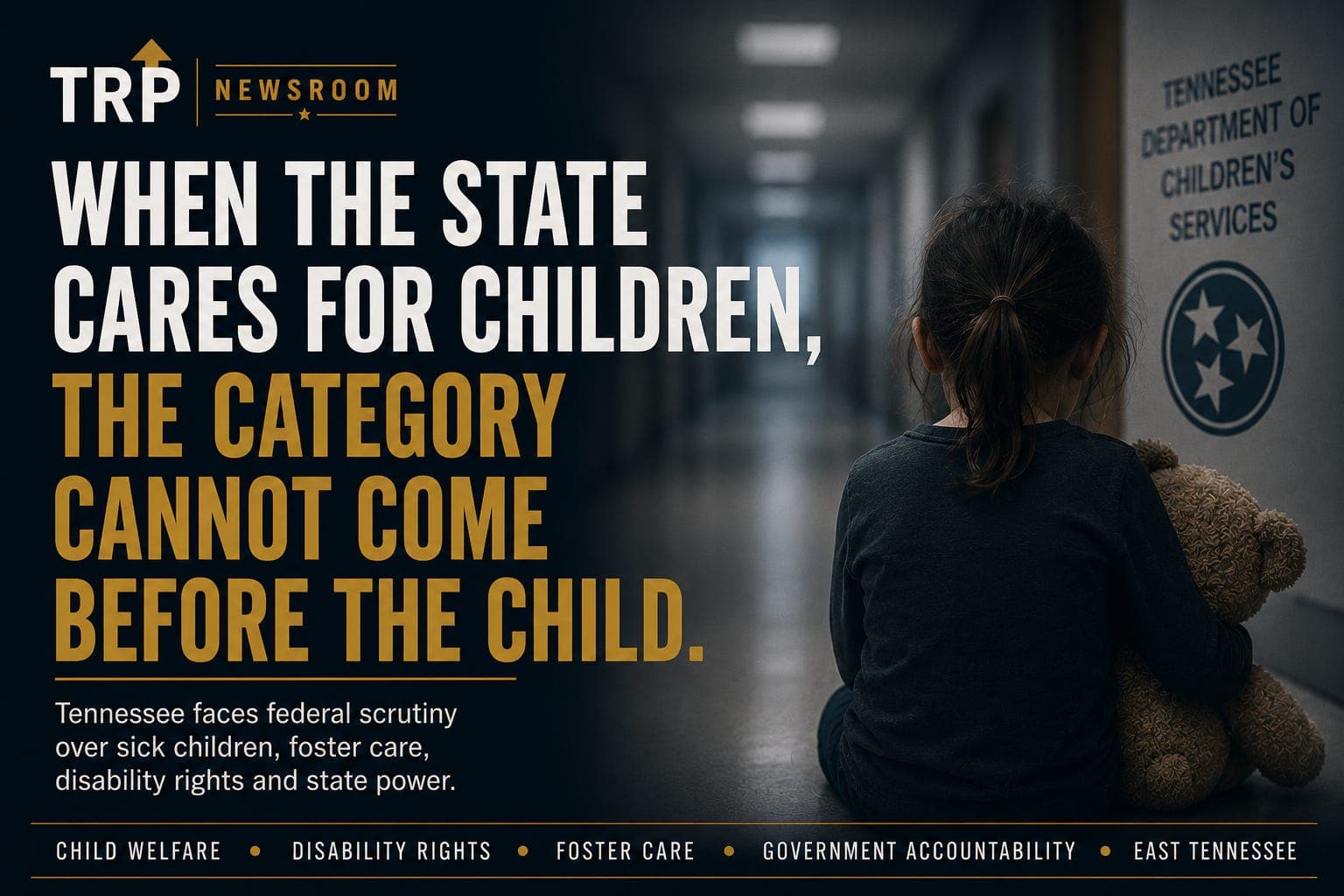
Tennessee has several child-related controversies moving at once.
One involves seriously sick immigrant children enrolled in a state health program. Another involves federal civil-rights complaints accusing the Tennessee Department of Children’s Services of failures involving children with disabilities, placements, removals, records and family rights. Others involve broader litigation and federal scrutiny around Tennessee’s foster-care and juvenile-justice systems.
They are separate cases, with different agencies, statutes and legal questions.
But they raise a shared public concern: whether Tennessee’s child-serving systems can provide care, process and accountability when the stakes are highest.
It is easy to sort the stories by category.
Immigrant children. Foster children. Disabled children. Children in state custody. Children in health programs. Children whose parents are accused of neglect. Children in facilities. Children in court.
That is how systems sort people.
It is not how the public should think about them first.
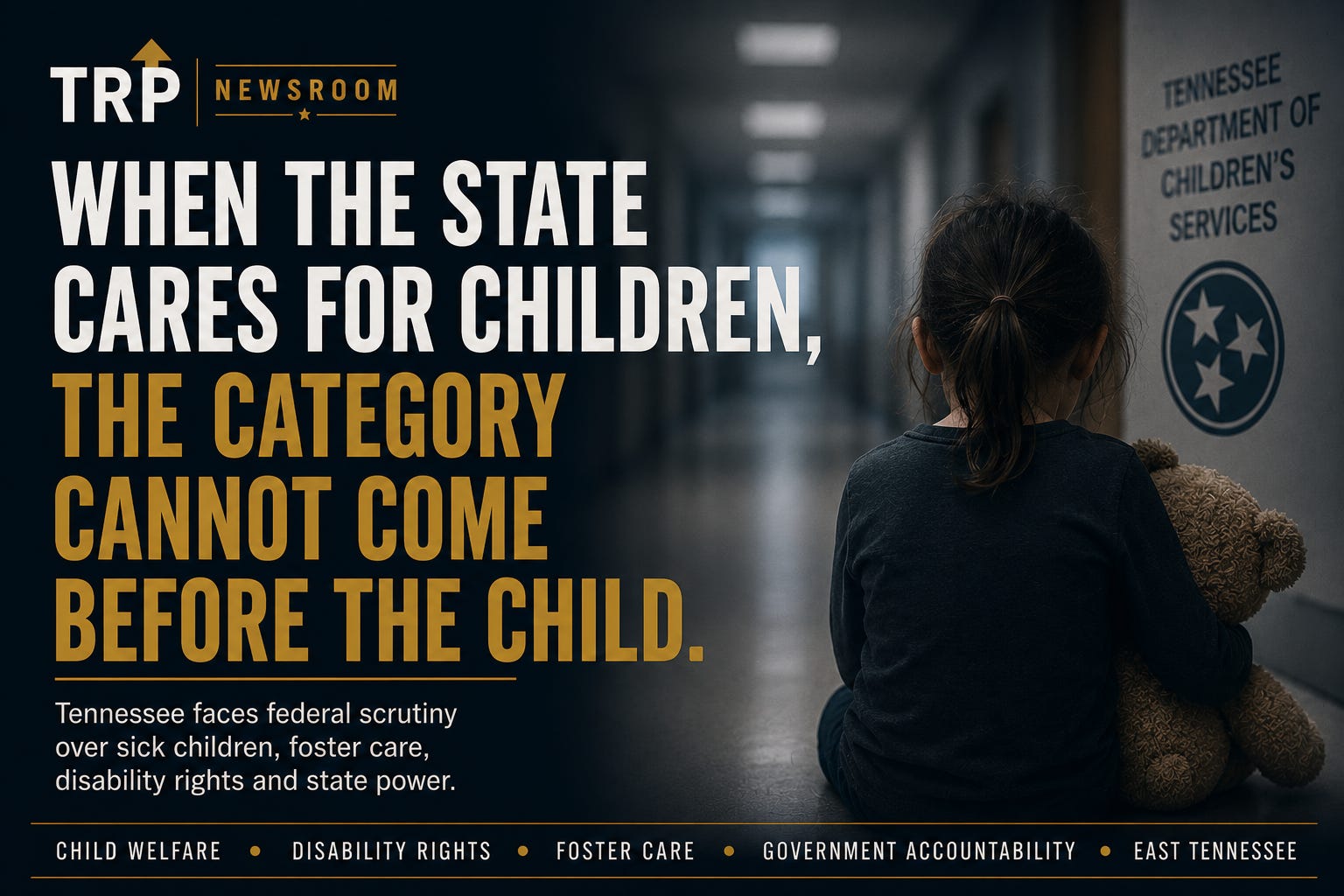
Before the category, there is the child.
That is the point Tennessee needs to sit with.
This is not a legal-versus-illegal story. It is not a partisan story. It cannot be reduced to one lawmaker, one lawsuit, one agency letter or one court order.
It is a care story.
And care is one of the hardest tests of government.
Government is not the family. It is not the church. It is not the neighbor, the doctor or the foster parent sitting at a kitchen table trying to calm a child after a placement move.
But government still has duties.
When the state removes a child from home, it assumes a burden. When it places a child in foster care, certifies a placement, keeps records that can affect parental rights, funds medical care or uses a child’s information for enforcement purposes, it assumes a burden.
That burden is legal.
It is also moral.
A Nashville judge recently paused part of a Tennessee policy that would have allowed state health officials to share identifying information about roughly 400 seriously sick and disabled immigrant children with immigration authorities. The order is temporary. It does not permanently strike down the law or decide the full case. But it pauses the reporting while doctors challenge the policy in court.
The children are enrolled in Children’s Special Services, Tennessee’s Title V program for children and youth with special health care needs. The state describes the program as providing access to comprehensive medical care for eligible children with physical disabilities from birth through age 21 and operating as a payer of last resort.
The doctors who sued argue the Department of Health misread Tennessee’s new public-benefits law, skipped required rulemaking and risked pushing medically fragile children away from care. The state’s broader policy interest is public-benefit enforcement and immigration-status verification.
That is one system.
Another is DCS.
Fourteen federal civil-rights complaints have been submitted to the U.S. Department of Health and Human Services Office for Civil Rights seeking review of DCS practices involving children with disabilities, removals from families and placements across multiple counties. Local reporting says the complaints allege disability discrimination, retaliation, falsified case records, removals without proper legal process, national-origin discrimination and failures involving children who were sexually assaulted in DCS-certified placements.
Those are allegations, not findings.
DCS has not publicly answered the specific complaints in the reporting reviewed. In prior statements cited by local media, the department has said it cannot comment on specific child cases but takes child safety seriously and cooperates with oversight agencies.
But the allegations are serious because they involve the kind of state power that can change the course of a child’s life.
Child removal is not paperwork. Placement instability is not a scheduling problem. A falsified record, if proven, is not an administrative inconvenience. A child with disabilities placed in the wrong setting is not merely a bad fit. A termination-of-parental-rights case is not just another court date.
These are government actions with permanent consequences.
The federal complaints are not the only pressure on Tennessee’s child-welfare system.
In 2024, the HHS Departmental Appeals Board upheld a decision to withhold $770,550 in federal Title IV-B and Title IV-E funds from Tennessee after concluding the state had not successfully met required outcomes tied to placement stability.
Tennessee DCS also faces an ongoing federal foster-care class action, Keira M. v. Commissioner Quin, filed on behalf of children in Tennessee foster care. Advocacy group A Better Childhood describes the lawsuit as involving more than 9,000 children in foster care, including a disability subclass for children with emotional, psychological, cognitive or physical disabilities.
Separately, Disability Rights Tennessee, Sanford Heisler Sharp and the Youth Law Center filed a 2024 federal lawsuit alleging Tennessee warehouses children with disabilities in prison-like juvenile justice facilities and subjects them to violence, abuse and neglect.
Those matters are not the same. They should not be blurred together as if every allegation has been proven.
But they point toward the same public question.
Can Tennessee protect children without losing sight of them?
That question gets harder when politics teaches people to ration empathy by category.
If the child is undocumented, some people stop caring. If a parent is accused by DCS, some assume the parent must be guilty. If a child is in foster care, some assume the state must have saved the child. If a family sues the state, some assume the family must be exaggerating. If a lawmaker transmits complaints, some reduce the story to the lawmaker’s party.
That is not serious.
A child’s category may matter legally. It may affect eligibility, process, funding, custody, privacy, immigration status, placement options and court authority.
But the category cannot erase the child.
A sick child is still sick.
A disabled child is still disabled.
A child removed from home still needs stability.
A child in custody still needs safety.
A child whose records are wrong still faces consequences.
A child in a facility still needs protection.
A child whose family is afraid of government still needs care.
There is a legitimate role for law. Tennessee has a right to enforce eligibility rules for public benefits. The state has a right to protect taxpayer resources. DCS has a duty to intervene when children are abused or neglected. Courts have a role in deciding custody, placement and parental rights. Federal agencies have a role in enforcing civil-rights rules when state programs receive federal money.
Law matters.
But law is not the same as care.
A system can be legally powerful and still be bad at care. It can generate records, hearings, placements, reports, acronyms and compliance documents and still fail the child whose life depends on the decision.
DCS has a hard job. That should be said plainly.
Child welfare sits in the middle of trauma, poverty, addiction, disability, mental illness, abuse, neglect, violence, family breakdown, court pressure, staff turnover, placement shortages and public anger. It is easy to criticize from the outside. It is much harder to make good decisions at 2 a.m. when a child may not be safe and there is nowhere appropriate to place him.
That difficulty is real.
But difficulty does not cancel accountability.
If anything, it increases the need for it.
Hard systems need stronger safeguards, not weaker ones.
If the state removes children, it needs accurate records. If the state places children, it needs safe placements. If the state serves children with disabilities, it needs disability-competent care. If the state seeks to terminate parental rights, it needs clean process. If the state receives federal money, it must follow federal civil-rights rules. If the state shares children’s information with enforcement agencies, it should explain why, how and what safeguards exist.
That is not anti-government.
That is accountable government.
The church and civil society also have a role. We cannot point at the state and pretend children belong only to agencies.
If families are collapsing, churches should be present. If foster parents need support, communities should support them. If mothers are afraid, someone should walk with them. If children need stable adults, adults should step forward.
The state is not built to love.
People are.
But when the state takes custody, funds care, certifies placements, keeps records or enforces rules, the public has the right to ask whether the state is caring well.
That is the issue in front of Tennessee.
Not one case.
Not one headline.
A pattern of hard questions.
Can the state enforce law without turning care into fear?
Can it remove children only with clean process and accurate records?
Can it place children with disabilities in settings built for their needs?
Can it admit failure before a lawsuit forces the admission?
Can it be trusted with the children it claims to protect?
Those questions deserve answers.
Because once the state touches the life of a child, “we meant well” is not enough.
Care has to be real.
Process has to be clean.
And accountability has to reach the child before the damage becomes permanent.
I am a retired detective and criminal justice / government educator based in Tennessee. I am a commentary write for Tennessee Lookout and a weekly columnist with Knox TN Today. My work examines public policy, public safety systems and civic responsibility. My reporting and commentary have also appeared in Governing, The Arizona Capitol Times, South Florida Sun Sentinel, Police1, among other state and regional outlets.